
Tenant not paying rent and not vacating: what to do in India
By Giridhar Reddy, founder of Domvio, Bengaluru
Updated
If a tenant in India stops paying rent, you cannot evict them yourself. Keep written reminders and records, send a lawyer's notice demanding the arrears and ending the tenancy, and if that fails, apply for eviction to the rent court, rent controller or civil court for your area. Changing locks or cutting power can put you in the wrong.
This is a sample for general information, not legal advice. Laws differ by state. It has not yet been reviewed by a lawyer. Have a lawyer examine it for your situation before you use or rely on it.
What you must not do, even when rent is months late
No self-help eviction
Do not change the locks, remove the tenant's belongings, cut electricity or water, block the entrance, or threaten or harass the tenant or their family. Only a court or rent authority can order a tenant out, and its order is carried out through the court, not by you.
Rent laws say this in so many words. Section 45 of the Delhi Rent Control Act, 1958 and section 49 of the Karnataka Rent Act, 1999 bar a landlord from cutting off or withholding an essential supply such as water, electricity, lights in passages and sanitary services without just and sufficient cause, and let the tenant ask the Controller to restore it (Delhi section 45 text). Courts, including the Supreme Court, have called electricity a basic amenity, and lawyers warn that cutting supplies to force a tenant out can lead to criminal trespass proceedings (SCC Times, Khaitan & Co). Self-help eviction also usually weakens your own case in court (iPleaders).
How to evict a tenant who is not paying rent, step by step
Talk first
Call or meet the tenant and ask what has happened: a lost job, a medical bill or a plan to move out. Many cases end here with a short payment plan. Whatever you agree, confirm it in a WhatsApp message the same day.
Send written reminders
Remind the tenant in writing on fixed dates, polite at first and firmer later. Dated written reminders show that you asked for rent and when. Use our rent reminder message templates, including the final reminder.
Gather your records
Put together the rent agreement, the record of every payment received (receipts, bank statements with UTR numbers, cash entries), the months that are unpaid, and your reminders and the tenant's replies. Courts decide on records. A rent tracker and a rent receipt for every past payment make this much easier.
Have a lawyer send a legal notice
A local lawyer drafts a notice that demands the arrears and, where needed, ends the tenancy under section 106 of the Transfer of Property Act, 1882 and your state's rent law. Send it by registered post with acknowledgement due (and also by email or WhatsApp if the agreement allows), and keep the postal receipts. To get your facts in order first, draft one with our eviction notice format and take it to the lawyer.
Wait out the notice period
Give the tenant the time the notice and the law allow. Under the Delhi and Karnataka rent acts, for example, a tenant who pays or tenders the full arrears within two months of a demand notice is protected on that ground (details below). Keep accepting rent only on your lawyer's advice, because accepting it can affect a termination.
File for eviction and recovery of arrears
If the tenant neither pays nor leaves, your lawyer files before the right forum: the Rent Controller, the Rent Court under a new tenancy law, or the civil court or Small Causes Court. The forum depends on your state and your tenancy (see the table below).
Get possession through the court
If you win, the order or decree is executed through the court. If the tenant still refuses to leave, the court's own process, with police help where ordered, hands back possession. Do not act on your own even with an order in hand.
Which law applies to your tenancy?
Tenancy is a state subject, so the answer depends on where the property is, when the building was built, what the rent is and what kind of agreement you have. Older rent control acts often protect only low-rent premises, which means many modern tenancies fall outside them and go to the civil court instead. Treat this table as a starting point for the conversation with your lawyer.
| Where and what | Law | Ground for non-payment | Where you file |
|---|---|---|---|
| Delhi, premises covered by the Rent Control Act | Delhi Rent Control Act, 1958, section 14(1)(a) | Tenant has not paid or tendered the full arrears within two months of a written demand served on them | Rent Controller |
| Delhi, monthly rent above ₹3,500 | Section 3(c) takes these premises out of the Delhi Rent Control Act, so the Transfer of Property Act and the agreement apply | Tenancy ended by notice; arrears claimed as money due | Civil court |
| Karnataka, premises covered by the Rent Act | Karnataka Rent Act, 1999, section 27(2)(a) | Tenant has not paid or tendered the full arrears within two months of a notice under section 106 of the Transfer of Property Act | Court named under the Act |
| Karnataka, premises outside the Rent Act | Section 2(3) of the Karnataka Rent Act excludes several kinds of premises. Karnataka High Court rulings have read it to exclude residential premises in city areas with rent above ₹3,500 and buildings built after the Act came into force | Tenancy ended by notice under section 106; arrears claimed as money due | Usually the Small Causes Court or civil court in Bengaluru (confirm with your lawyer) |
| States with a new tenancy law based on the Model Tenancy Act | Model Tenancy Act, 2021 as adopted by the state | Failure to pay rent for two consecutive months or more | Rent Authority, then Rent Court and Rent Tribunal; civil courts have no jurisdiction |
The Model Tenancy Act is not law everywhere
The Model Tenancy Act, 2021 is a model the Centre asked states to adopt; it does not apply on its own. According to an August 2025 Rajya Sabha reply reported by the Free Press Journal, Assam, Arunachal Pradesh, Andaman and Nicobar Islands, Dadra and Nagar Haveli and Daman and Diu, and Lakshadweep have adopted tenancy laws based on it, while Andhra Pradesh, Tamil Nadu, Uttarakhand and Uttar Pradesh have laws based on an earlier draft. We could not find Karnataka, Delhi or Maharashtra on that list. Viral posts about "new rent rules 2026" describe this model, not a law that applies to you. Read what the Model Tenancy Act says.
Both the Delhi and Karnataka figures above come from decades-old acts that have been amended over time, and we could not open the official consolidated text on India Code while writing this. Your lawyer should confirm the current wording before relying on any section number or rent threshold.
What a legal notice for non-payment of rent usually contains
Sample outline only, not a notice
This list is here so you know what to give your lawyer and what to expect. Have a lawyer draft and send the notice. A notice with the wrong dates, period or grounds can delay your case by months.
- Names and addresses of the landlord (or the lawyer on the landlord's behalf) and the tenant.
- Address of the property and the date and key terms of the rent agreement: rent, due date, deposit.
- The months unpaid and the total arrears, with the dates of your earlier reminders.
- A demand to pay the arrears within a stated period.
- Where the tenancy is being ended, the termination and the date by which the tenant must hand over vacant possession, in line with section 106 of the Transfer of Property Act or the agreement.
- That further legal action will follow if the tenant neither pays nor vacates.
- Date, signature and mode of sending (registered post with acknowledgement due).
Can you adjust the security deposit against unpaid rent?
Usually yes at the end of the tenancy, if the agreement allows deductions for unpaid rent, and you must account for every rupee in writing. Adjusting the deposit mid-tenancy does not end the tenancy and does not entitle you to take the flat back. If you use it, tell the tenant in writing which months it covers. In states that adopt the Model Tenancy Act, the deposit for residential premises is capped at two months' rent (PRS India), so it will not cover a long default. For Bengaluru practice, read security deposit rules in Bangalore.
How long does it take to evict a tenant for non-payment?
There is no fixed answer. The Model Tenancy Act asks rent courts to try to decide cases within set timelines, with 90 days for non-payment of rent (PRS India), but only in states that have adopted it. In civil courts and older rent control courts, cases often run for many months and can take years, depending on the city, the court's workload and whether the tenant contests or appeals. Plan for the long route, and keep trying to settle along the way: an agreed exit date and a written payment plan are often faster than a decree.
What if the tenant pays after the notice?
Rent acts give tenants a chance to clear arrears. In Delhi, section 14(2) says no eviction order is made on the arrears ground if the tenant pays or deposits as the Act requires. In Karnataka, section 27(2)(a) lets the court order eviction unless the tenant pays or deposits the arrears within one month of the order, but a tenant who already had this benefit once for the same premises does not get the notice benefit again. That is one more reason to keep a clean, dated record of every late month. Unpaid rent can be claimed in court for three years from when it fell due; see landlord rights in India.
Tenant not vacating after the rent agreement expires
When the agreement ends and the tenant stays on, you still cannot remove them yourself. If you keep accepting rent, section 116 of the Transfer of Property Act, 1882 can treat the lease as renewed month to month, so write to the tenant before the end date saying you will not renew, and do not accept rent as if the tenancy continues. Where a state has adopted the Model Tenancy Act, a tenant who overstays owes compensation of twice the monthly rent for two months and four times after that (PRS India). Otherwise the route is the same as for unpaid rent: a lawyer's notice, then the rent court or civil court.
How to prevent a rent dispute in the first place
The landlords who come out of a dispute well are the ones with paperwork. Each of these steps takes minutes at the start of a tenancy and saves months later.
- A written, signed and, where required, registered rent agreement with the rent, due date and notice period. See rent agreement format.
- Tenant police verification before move-in. See tenant police verification.
- Rent paid by UPI or bank transfer, not cash, so there is always a reference number. See how to collect rent online.
- A receipt for every payment, so neither side can later dispute what was paid.
- Reminders sent in writing on the same days every month, so a missed payment is noticed in days, not months.
Build the payment record as you go
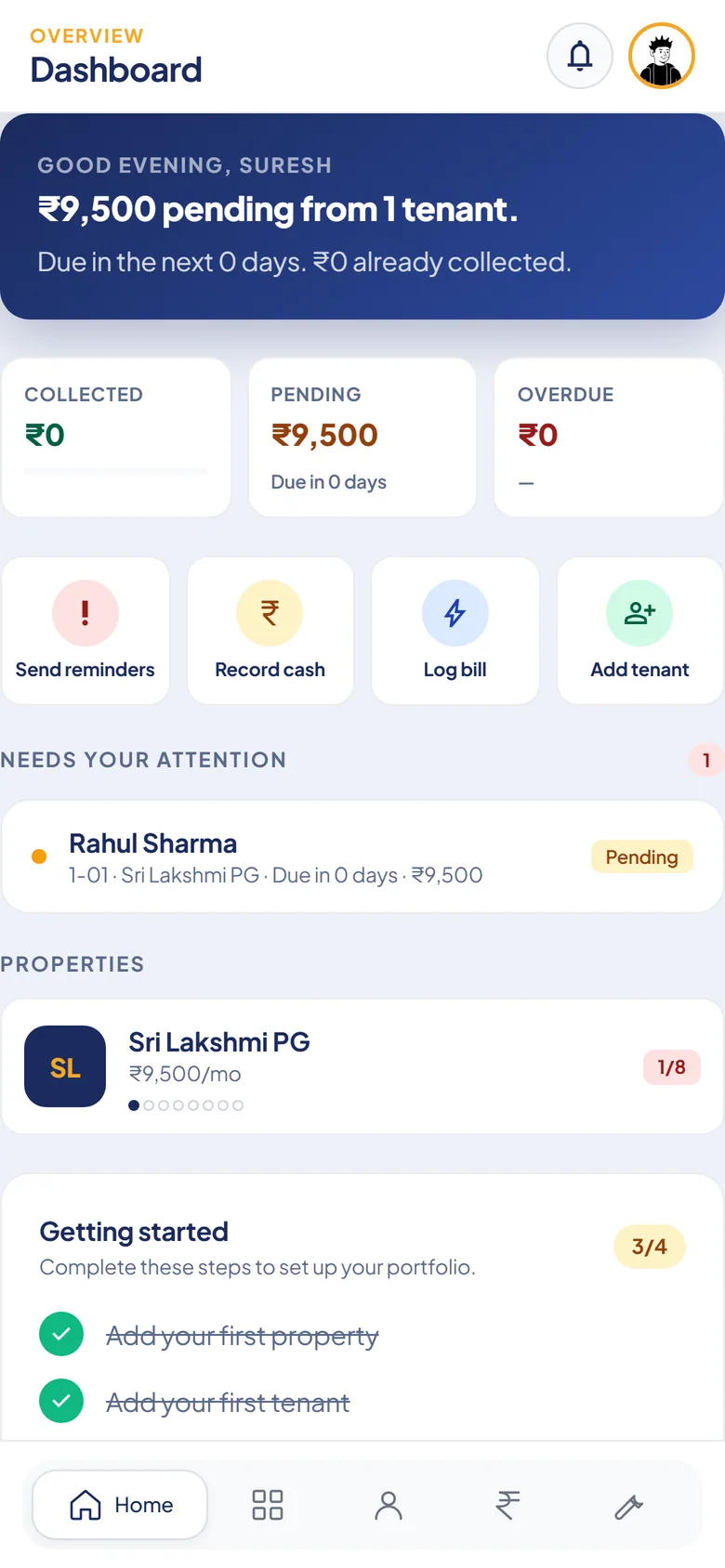
Domvio sends every tenant a WhatsApp reminder three days before rent is due, records each UPI or cash payment you confirm, and sends you and the tenant a PDF receipt. Your dashboard shows who is paid, pending and overdue. If a tenancy ever goes wrong, you already have dated reminders and receipts for every month. See the rent collection app.
Frequently asked questions
Can I cut the electricity or water if my tenant does not pay rent?
No. Rent laws such as section 45 of the Delhi Rent Control Act and section 49 of the Karnataka Rent Act bar landlords from cutting off essential supplies, and doing it to force a tenant out can lead to criminal proceedings. Recover rent through a legal notice and the courts.
How many months of unpaid rent before I can evict a tenant?
It depends on your state's law. Under the Delhi and Karnataka rent acts, the ground arises when the tenant does not pay the arrears within two months of a written demand. Under laws based on the Model Tenancy Act, it is non-payment for two consecutive months or more.
Can I send a legal notice to my tenant myself?
A notice under section 106 of the Transfer of Property Act can be signed by you or on your behalf. In practice, have a lawyer draft and send it, because mistakes in dates, periods or grounds can delay the case.
Will the police evict a tenant who is not paying rent?
Generally not on their own. Non-payment of rent is decided by the rent controller, rent court or civil court, and possession is handed back by executing that order. Police help comes when the court orders it.
My tenant has no written rent agreement. Can I still evict them?
Yes, the person is still your tenant, and the Transfer of Property Act treats an unwritten residential tenancy as month to month unless something else is proved. Your proof of rent paid, such as bank statements and receipts, becomes even more important.
I live abroad. How do I handle a tenant who stopped paying?
You can act through a local lawyer, and many NRIs give a trusted person a power of attorney to appear for them; ask your lawyer what your court needs. Keep reminders and receipts in one place you can reach from anywhere; see NRI property management.
Stop chasing rent every month
Domvio reminds your tenants on WhatsApp, takes rent straight to your UPI ID and sends PDF receipts automatically. Free during early access.